Dish guide
Fresh rice rolls in Hanoi
How Hanoi serves fresh rice rolls: the northern name nem cuốn, what a roll usually holds, how to dip, and how this plate differs from fried nem rán.
Hanoi Taste Tours Editorial Team
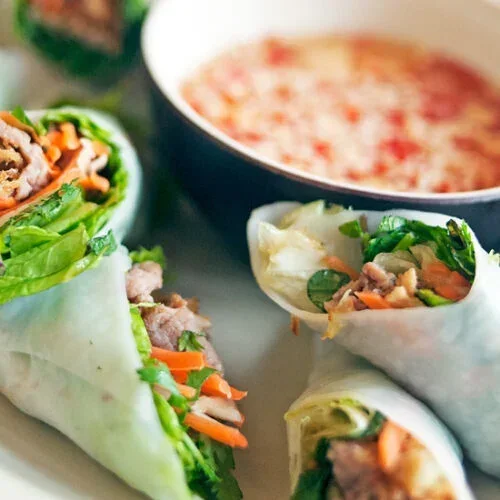
A fresh rice roll is a cool bite in a city that also loves hot broth. The wrapper is rice paper, softened, not steamed from batter and not fried. You see the filling through it. That transparency is the point: herbs, a shred of vegetable, and usually a little meat or shrimp, rolled tight enough to hold and loose enough to taste each layer.
On an English menu the same plate is often called a spring roll, a summer roll, or a fresh roll. In Hanoi the useful Vietnamese name for the unfried roll is *nem cuốn*. The fried cousin is *nem rán*, and in much of the south that fried roll is *chả giò*. Vietnam News has noted that in Hanoi a short order for *nem* is commonly understood as the fried roll. If you want the cool one, say nem cuốn, or point at the plate. Pointing is not a failure of manners. It prevents the wrong cooking method.
What the roll is made of
*Bánh tráng* is the dried rice sheet. It is dipped in water until it bends, then filled and rolled. It is not the cloth-steamed sheet of bánh cuốn, which starts as batter. A fresh roll’s wrapper stays supple. If it tears, the cook usually rolls again; a split wrapper is a handling problem, not a different dish.
A familiar filling includes lettuce or another soft leaf, herbs, a few rice vermicelli strands, and pork, shrimp, or both. Carrot or cucumber may show as colour. None of those items is guaranteed by the English words “fresh rice roll”. Some rolls are shrimp-forward. Some are mostly herbs and pork. A vegetarian roll exists in kitchens that make one; a standard roll is not vegetarian merely because you can see lettuce.
The dip is part of the plate. *Nước chấm* — fish sauce, lime or vinegar, sugar, chilli, often garlic — is common. A thicker sauce with peanut is also served, especially where the kitchen expects visitors who know that version from abroad. Do not assume peanut from a pale orange colour. Ask if peanut, sesame or shrimp paste matters to you. Fish sauce is the more ordinary salt in a Hanoi dip, and “not spicy” does not remove the fish.
How people eat it
The roll is usually a shared plate or a light course, not the charcoal lunch that bún chả is. You take one, dip an end, and eat it in a bite or two. Stuffing the whole roll into the bowl collapses the herbs. Extra lettuce and herbs, when they come beside the rolls, are for wrapping a second layer if you want more leaf — not a second dish you must finish.
Eat them soon. Rice paper dries and sticks to the plate, and a herb roll that waits loses the contrast between cool leaf and soft wrapper. This is finger food or chopstick food depending on the table. Either is ordinary.
What the photographs show
The homepage card “Fresh rice rolls” is the hero of this page. The frame shows several cut rolls: a translucent wrapper, green leaf, orange carrot, herbs, and pale strips of cooked meat. A black bowl holds a creamy, pale-orange sauce. The photograph does not show shrimp clearly, does not name the sauce, and does not show a restaurant.
A second homepage photograph, the sunlit table in “Details from the table”, is a different plate of the same family: whole rolls with pink shrimp visible at the ends, a basil sprig, shredded pickle, a small bowl of red sauce, and a glass of tea. That frame is not the card photograph. It is still a fresh roll, not a fried one. Neither picture is a menu.
What it is not
It is not crisp spring rolls. Those are fried, hot, and in Hanoi usually called nem rán. It is not bánh cuốn. It is not a guarantee that the kitchen skipped fish sauce, peanut or gluten in a peanut sauce. Rice paper is rice; a sauce beside it can still contain wheat, peanut or shellfish.
If you are ordering for someone who avoids shellfish, do not rely on a roll that “looks like vegetables”. Shrimp can sit at the end, in the middle, or in the sauce.
With a guide
Hanoi Old Quarter Food Journey and Hanoi Signature Taste Journey are private days on which a fresh roll can be discussed. A photograph on this site is an example. The written proposal says what is actually served. Sending an enquiry does not book the plate.